Burnaby
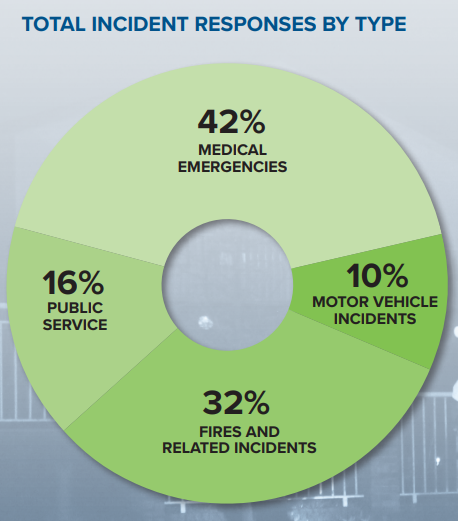
PAGE 11: BURNABY FIRE DEPARTMENT ANNUAL REPORT 2020
North Vancouver
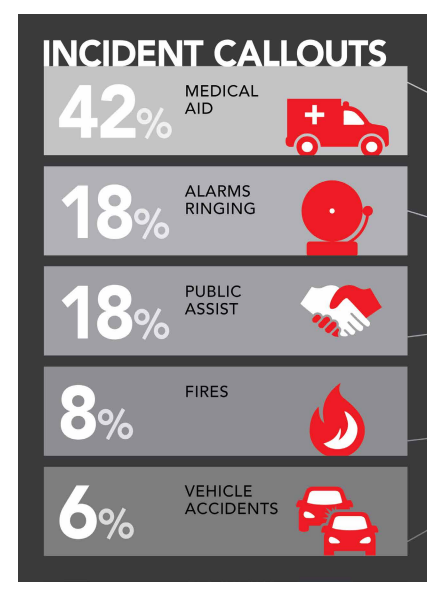
PAGE 17: District Of North Vancouver Fire And Rescue Annual Report 2021
Vancouver
Vancouver Fire Rescue Services
Strategic Plan 2019 – 2021
PAGE 6: To provide a clearer perspective of how busy VFRS is, in 2018 VFRS saw 82 incidents per 1,000 residents, while the Canadian fire services average ranged between 26 and 53 incidents per 1,000 residents. VFRS’ halls responded to an average of 2,794 incidents, while most other Canadian metro cities were in the 1,500 range. Vancouver fire fighters respond on average to twice as many incidents as the average fire fighter in any other Canadian city.
VFRS Services: Fires, Hazardous material events, Medical emergencies, Marine responses, Motor vehicle incidents, Technical rescue incidents, Public service calls, Special operations
This CTV news story provides some details on the types of calls ambulances attend, a majority have been related to the overdose crisis.
Just not sustainable’: B.C. ambulance paramedics responded to an estimated 1M calls last year
Jan. 18, 2022 Excerpts: “Last year was the deadliest year for drug overdoses in B.C.’s history, and data released by BCEHS last week showed it was also the busiest for paramedics responding to the overdose crisis, by a wide margin. That data showed BCEHS responded to 35,525 overdoses in 2021, an increase of 31 per cent compared to the previous year, and nearly triple the 12,263 it responded to in 2015.”
Severe weather events and the ongoing COVID-19 pandemic also exacerbated staffing issues and lengthy wait times for those calling for emergency care.
BC Emergency Health Services provides current and historical data on community call volumes and overdose response:
Overdose & Drug Poisoning Data (opens in a new tab)
These three articles discuss noise complaints in Vancouver neighbourhoods, but emergency vehicles are not included:
Global News
July 12, 2016: Noise city: Vancouver’s noisiest neighbourhoods
North Shore News
Nov 17, 2021: City of North Van cracking down on urban noise
Vancouver Sun
October 9, 2018: TransLink to take action on excessive SkyTrain noise
Excerpt: “TransLink hired a consultant to conduct the study and also convened a community advisory committee made up of a dozen residents who had lodged noise complaints.
Between February and June, measurements and observations were made at 32 locations across the train network, and inside a test train… In some cases, the maximum noise levels measured were around 90 decibels, or the sound of a loud car horn at a distance of three metres. One area that had noise levels of 90 decibels or higher was in between VCC-Clark and Commercial-Broadway stations.
In 1996, the [Vancouver] Urban Noise Task Force was formed to address growing concerns regarding the apparent increase in adverse effects of noise on everyday life in Vancouver.
See the Final Report: Report of the Urban Noise Task Force City of Vancouver, April, 1997
Here is an excerpt from the Executive Summary:
City Noise is the product of the efforts of a group of citizens brought together by Vancouver City Council in March 1996 to form the Urban Noise Task Force. A total of 13 meetings of the entire committee plus additional meetings of subcommittees were held between March and July, resulting in the release of an Interim Report at the end of July. During the summer, public input was gathered through a contracted telephone survey of 1,000 citizens. Public input was also obtained via letters, e-mail and telephone calls from more than 250 individuals and groups, including both Vancouver-based groups and organizations from outside Vancouver. Two public meetings were held at Robson Square on October 9th. In addition to public input, information was also obtained from invited presenters at the meetings of the Task Force (see Appendix I for list). During late 1996, an additional five meetings of the Task Force resulted in the production of this Final Report.
Victoria
Ambulance service to reduce number of “lights & siren” responses
Victoria Times-Colonist, 2013
The Canadian Automobile Association (CAA) provides this briefing on Traffic Incident Management, dated 2017:
*SEE PAGE 8: INCIDENT RESPONSE COORDINATION
A critical component of effective TIM is coordination among all of the relevant entities. Specific entities involved may vary to some degree from incident to incident, but would typically involve the police, highway service patrol (where available) or highway maintenance personnel and tow trucks. Other entities that may be involved depending on the nature and severity of the incident include emergency medical services, fire services, utilities and public security agencies.
*SEE PAGE 10: IMPLEMENTATION CONSIDERATIONS
As has been illustrated above, TIM practices tend to offer significant congestion relief benefits at modest cost. There are probably two key reasons why TIM practices have not received as much attention in Canada as they deserve. Affordability & Little public information in Canada…
